
Kenakare Trip Advisors
Africa's largest canyon, a geological marvel carved over millions of years by the meandering Fish River. Stretching for over 160 kilometres and plunging to…
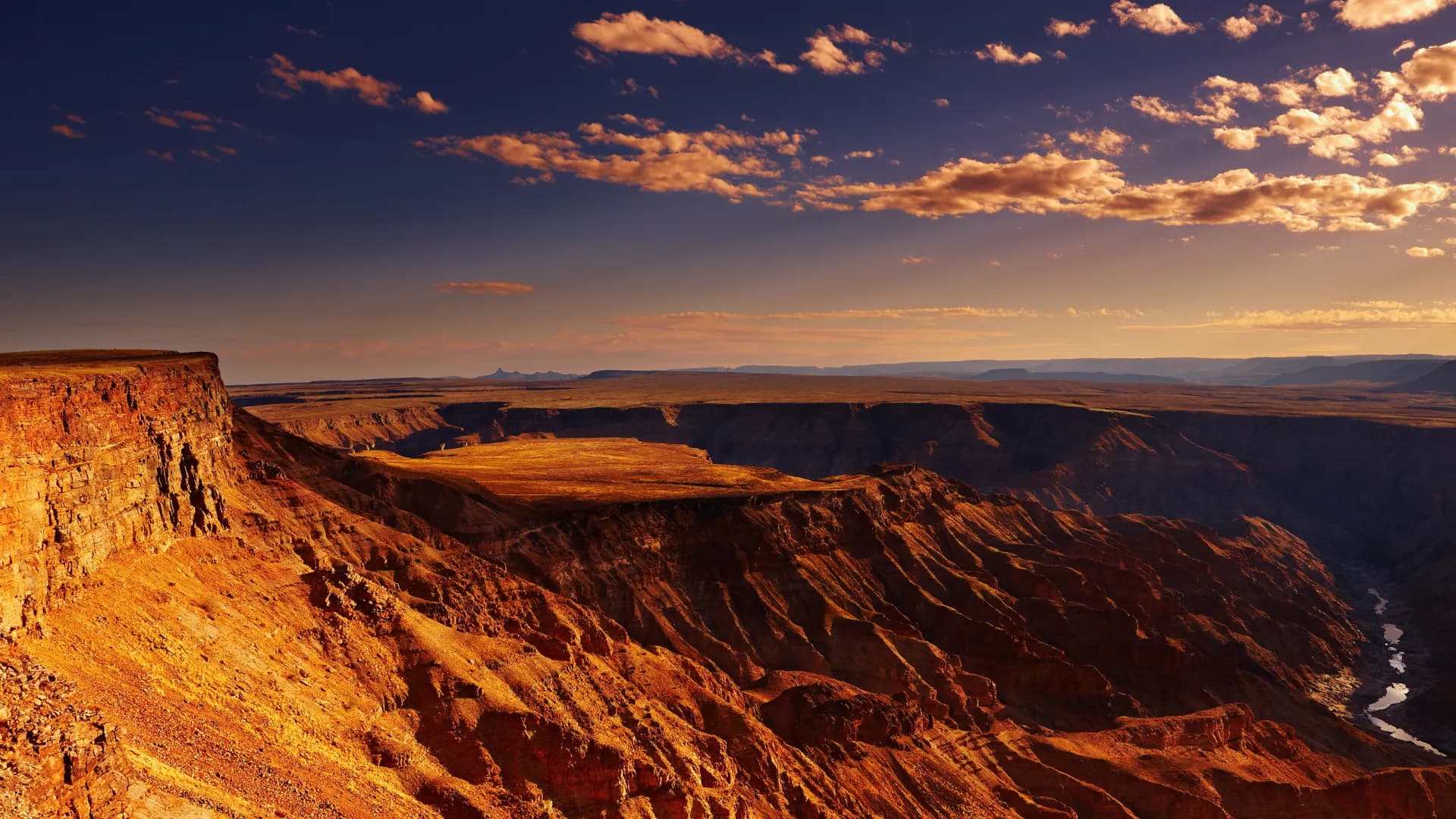
Africa's largest canyon, a geological marvel carved over millions of years by the meandering Fish River. Stretching for over 160 kilometres and plunging to depths of 550 metres, it offers breathtaking vistas and hiking adventures amidst rugged desert landscapes. Witness the raw power of nature and marvel at the ancient rock formations that tell the story of this timeless wonder.
A half-day guided drive along the southern rim of Fish River Canyon — the second largest canyon in the world after the Grand Canyon, measuring 160 km in length, up to 27 km in width, and 550 metres deep at its most profound point. The canyon was carved by the Fish River over the course of approximately 500 million years, making the exposed rock walls a readable record of geological time that stretches from the Precambrian basement to relatively recent Gondwana-era sediments. The standard viewpoint at Hobas is just the beginning: your guide takes you to the less-visited rim points further south where the canyon bends and the geometry changes completely, revealing the sinuous track of the ancient river through the rocky gorge floor far below. The canyon is home to leopard, mountain zebra, klipspringer, and over 60 species of reptiles; chacma baboon are the most reliably seen, traversing the canyon walls with casual ease. Your guide explains the canyon's complex geological history, the Nama people who have lived in the surrounding landscape for millennia, and the ecology of the canyon bottom — permanently watered by the seasonal Fish River, it supports a luxuriant riparian forest visible from the rim as a green line winding through the orange and grey canyon walls. Best in the early morning light when shadows define the canyon's structure. Hobas entry fees included.
One of Africa's great wilderness hikes: a 90 km, 5-day self-guided trail along the floor of the Fish River Canyon, following the ancient riverbed from the Hobas entry point south to the Ai-Ais Hot Springs Resort. The trail is accessible only from May to September (the canyon is closed in summer due to flash flood risk), and hikers must be medically certified fit before the permit is issued — the canyon floor is a demanding environment of deep sand, boulder scrambles, rocky river crossings, and temperatures that routinely exceed 30°C even in winter. In return, the canyon floor offers an extraordinary experience available no other way: camping on white sand beaches under the towering canyon walls, with the sounds of jackals, nightjars, and the rushing Fish River as accompaniment; wading through knee-to-thigh-deep river crossings (sometimes more in high water); watching the canyon walls change colour — from deep red at sunrise to pale ochre at midday to purple-pink at dusk; and walking for hours through a landscape where the canyon walls rise 400–500 metres on either side and the sky is a thin blue ribbon above. The trail requires complete self-sufficiency for 5 days: hikers carry all food, cooking equipment, and sleeping gear. Water is available from the river (filter required). Permits obtained from Hobas. Group size 3–40 persons. This listing is for guided trail assistance and logistics coordination; permit fees separate.
At the southern end of the Fish River Canyon, where the canyon opens and flattens out toward the Orange River valley, the extraordinary Ai-Ais Hot Springs emerge from the ground at 60°C — hot enough to cook an egg, too hot to enter untreated. The NWR Ai-Ais Hot Springs Spa has channelled this water into a series of pools cooled to comfortable bathing temperatures: outdoor pools with views across the surrounding mountains and valley, indoor thermal pools for year-round use, and a jacuzzi system fed directly from the spring. The springs are rich in fluoride, chloride, and sulphate minerals whose combination is traditionally credited with therapeutic properties — the name Ai-Ais means 'scalding hot' in Nama, and the springs have been used by indigenous inhabitants for at least several centuries. The spa facilities also include a sauna, steam room, and massage treatments. After the Fish River Canyon hike (if completing the 5-day trail), arriving at Ai-Ais and immersing sore muscles in the thermal pools is one of the most pleasurable moments available anywhere in southern Africa. Half-day or overnight access available. Day visitors can use the pools, spa facilities, and NWR Ai-Ais restaurant. Towels and locker facilities provided.
