
Kenakare Trip Advisors
A picturesque coastal town in Namibia, known for its colorful colonial architecture, rich diamond mining history, and stunning ocean views. Situated on the…
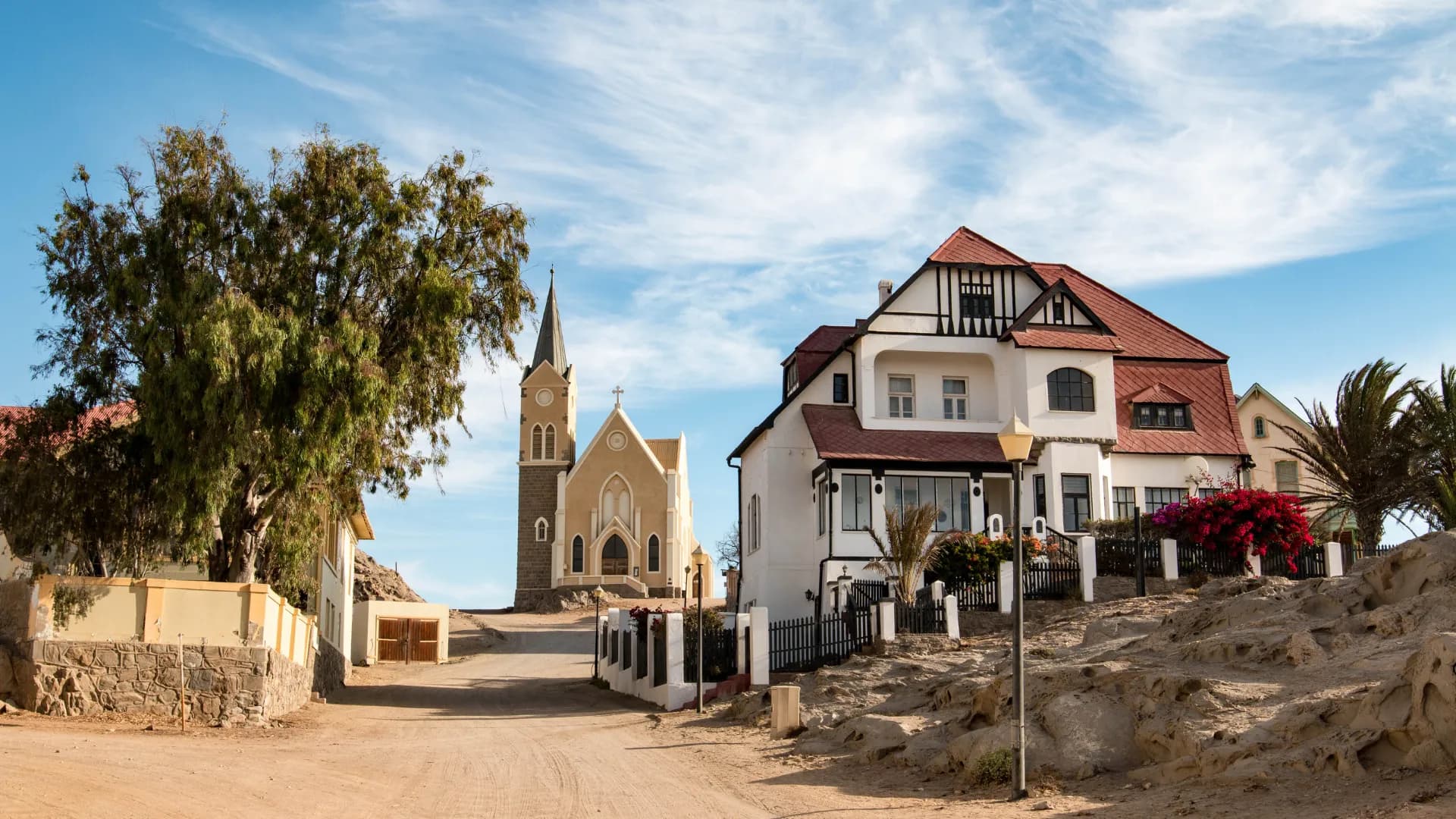
A picturesque coastal town in Namibia, known for its colorful colonial architecture, rich diamond mining history, and stunning ocean views. Situated on the windswept shores of the Atlantic Ocean, Lüderitz offers visitors a unique blend of German colonial charm and rugged natural beauty. Explore the town's historic buildings, including the iconic Felsenkirche (Church on the Rock), visit nearby attractions such as Kolmanskop ghost town and Diaz Point, and indulge in fresh seafood while taking in breathtaking sunsets over the ocean.
Kolmanskop is simultaneously one of Africa's most photographed places and most haunting: a once-thriving German colonial diamond-mining town, 10 km inland from Lüderitz, that was abandoned in 1956 when the accessible diamond deposits shifted south — and has been slowly consumed by the Namib Desert ever since. The guided tour enters through a series of rooms where fine-grained Namib sand has infiltrated through doors, windows, and broken roofs, creating extraordinary interior dune formations: sand banked waist-high against art deco walls, rooms lit by shafts of light through holes in the ceilings, corridors where you wade through sand to reach the next doorway. The buildings include the former hospital (which had Namibia's first X-ray machine), the bowling alley, the casino, the ballroom, the skittle alley, and dozens of family homes — their walls still decorated with original German tile work and paint. Your guide explains the extraordinary social history of early 20th-century diamond rush life, the gambling and excess of the boom years, and the rapid, total abandonment that followed the shift in fortune. Guided access 08h00–12h00 and 14h00–17h00. Photography strongly encouraged — this is perhaps the finest abandoned-building photography location in Africa. Entry permit and guide included.
A guided full-day 4x4 expedition from Lüderitz into the restricted Sperrgebiet National Park — the 'Forbidden Diamond Area' established by the German colonial government in 1908, one of the most restricted tracts of land in Africa, whose extraordinary prohibition preserved the landscape within it almost completely intact for over a century. The route heads south through increasingly desolate desert, stopping at ghost towns whose walls are silting up under the advancing dunes: Pomona, a diamond-rush settlement whose once-grand buildings now lean and crumble under rooftops of sand, its bowling alley and casino still identifiable beneath the drifts. The climax of the day is Bogenfels — a natural rock arch at the very edge of the Atlantic Ocean, 55 metres high and roughly equivalent in scale to a 20-storey building, formed by millennia of wave erosion in the black granite cliffs. Standing at its base, with the cold Benguela swell thundering through the arch and the dune sea stretching north behind you, is an experience with very few equivalents in Africa. Diamond history — the miners, the concession holders, the industrial-scale extraction methods, and the human cost — is discussed throughout. Includes coffee, tea, crisp sparkling wine, a full lunch, Namibian beer, cooldrinks, and water. 07h45–17h00. Min 4 pax.
The full Bogenfels & Diamonds experience conducted with guests in their own vehicles, following a guide vehicle through the restricted Sperrgebiet National Park access roads. This option suits guests who prefer the freedom and comfort of their own 4x4 — typically self-drivers who have traveled through Namibia and feel more at home in their own vehicle than a shared charter. The route is identical to the guided version: ghost towns being reclaimed by the dunes, the vast restricted diamond landscape where GPS signals are monitored, and the extraordinary Bogenfels rock arch at the continent's edge. Your lead guide travels ahead to clear access checkpoints, explain geological features and diamond history at each stop, and ensures the convoy moves efficiently through the Sperrgebiet within the limited access window. A valid Sperrgebiet access permit (included in the rate) is required for all passengers. Includes coffee, tea, crisp sparkling wine, a full lunch, Namibian beer, cooldrinks, and water. 07h45–17h00. Min 8 pax.
A guided half-day excursion to Elizabeth Bay — a diamond mining settlement 30 km south of Lüderitz that operated between 1991 and 1996 and was abruptly abandoned when the accessible alluvial diamond deposits were exhausted. Unlike the older ghost towns of the Sperrgebiet, Elizabeth Bay's industrial-era ruins are hauntingly recent: the processing plant machinery is still identifiable, the managers' houses still have curtains in the windows, and the township area still has furniture visible through broken panes. The experience is closer to urban exploration than conventional tourism — your guide provides the historical and social context for what you're seeing, explaining how the diamond industry worked in the late apartheid era, the economics that drove the rush, and the human stories of the workers and managers who lived in this remote, surreal settlement until it was walked away from almost overnight. Access is through the Sperrgebiet National Park checkpoint. Includes coffee, tea, crisp sparkling wine, snacks, Namibian beer, cooldrinks, and water. 08h30–13h00. Min 4 pax.
The Elizabeth Bay abandoned diamond town experience as a guided self-drive for guests travelling in their own vehicle. Your lead guide vehicle clears the Sperrgebiet National Park checkpoint and leads the convoy to Elizabeth Bay, stopping at key points in the processing plant, residential area, and harbour infrastructure to explain the history of this extraordinary industrial ghost town. Elizabeth Bay is often overlooked by visitors focused on the older and more photogenic Kolmanskop, but its very recentness makes it arguably more unsettling: these buildings were inhabited within living memory, yet the desert is already advancing through the windows. Valid Sperrgebiet access permits included for all passengers. Includes coffee, tea, crisp sparkling wine, snacks, Namibian beer, cooldrinks, and water. 08h30–13h00. Min 8 pax.
A short but genuinely special boat excursion from Lüderitz Harbour to Halifax Island — home to one of only a handful of African penguin (Spheniscus demersus) colonies in Namibia, and one of the most accessible. The island lies approximately 1.5 km south of Lüderitz and landing on it is not permitted (to protect the breeding colony), but the boat approaches close enough to observe the penguins at their burrows and in the water at very close range. African penguins — the only penguin species on the African continent — are classified as Endangered; the Halifax Island colony is part of a carefully monitored conservation effort. The surrounding waters are also rich: Cape Fur Seals haul out on the island's rocks, Cape gannets plunge-dive for anchovies offshore, and both greater and lesser flamingos are reliably seen in the sheltered waters between the island and the shore. The cold Benguela waters produce remarkably clear visibility from the boat, and on calm days the underwater silhouettes of swimming penguins are visible from deck level. Transfer by rigid inflatable from Lüderitz Harbour. Min 4 pax.
A guided walking tour through one of the best-preserved collections of German Jugendstil (Art Nouveau) architecture outside Europe — which exists, improbably, on a windswept Atlantic peninsula in the Namib Desert. Lüderitz was established in 1883 as the first German colonial foothold in South West Africa, and the diamond rush of 1908 funded a rapid building programme that produced a town of remarkable architectural ambition: the Goerke House (the mining director's mansion, now a museum), the Felsenkirche (1912, the pink granite cliff church visible from most of the town), the Lüderitz Buchhandlung (bookshop), the Deutsche Afrika Bank, the Kaiserliche Post, and dozens of private houses in blues, pinks, ochres, and greens. Your guide — a local historian — explains the political history of German South West Africa, the brutal Herero and Nama genocides that form the dark background to this architectural elegance, and the way Lüderitz has grappled (and often not grappled) with this history in the post-independence era. The tour ends at a seafood restaurant where Lüderitz crayfish — harvested directly from the cold Benguela waters below the town — is the obvious order. Duration approximately 2 hours.
A half-day drive around the extraordinary Lüderitz Peninsula — arguably the most geologically and ecologically varied piece of coastline in Namibia. The route heads south from town across a landscape of black granite inselbergs and orange-sand flats to Diaz Point, where a replica cross marks the spot where Portuguese navigator Bartolomeu Dias erected a padrão (stone cross) in 1488 — the first European to reach this coast, sailing as far south as any European had ventured at that time. The cold Benguela swell crashes against the rocks below the cross with genuine drama on almost any day of the year. From Diaz Point, the route continues through the flamingo-rich shallows of Sturmvogel Bay, where hundreds of greater and lesser flamingos feed in the shallows within 30 metres of the track, to the lookout above Agate Beach and back through the dunes to town. En route your guide explains the extraordinary geology of the peninsula — ancient Precambrian basement rocks polished smooth by millions of years of wind and wave — and the birdlife of the lagoon system. A concise and beautiful way to see Lüderitz's natural and historical context in a single morning or afternoon.
